320,000 Viewers Watched the “Rigged Election” Final Debate
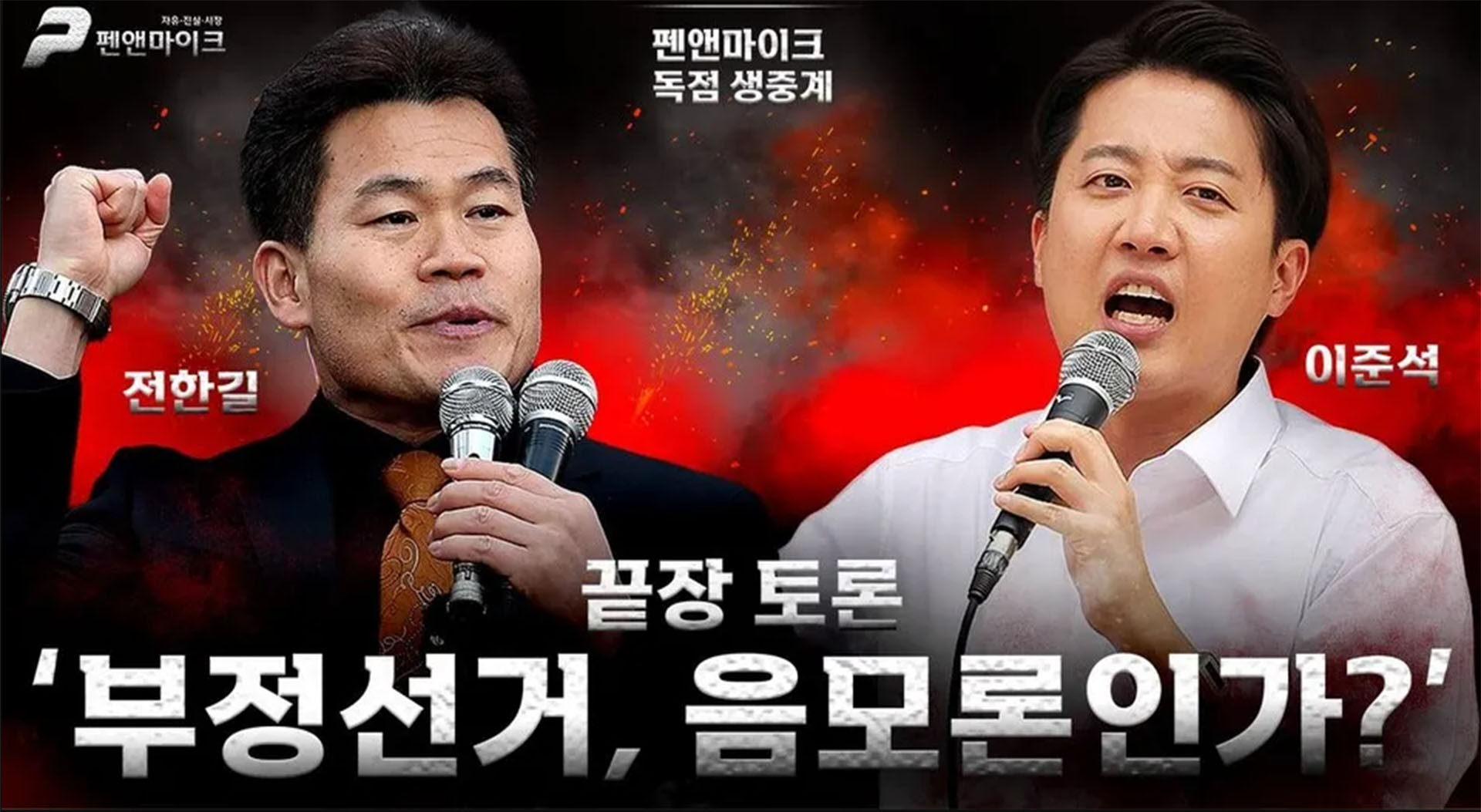
Lee Jun-seok vs. Jeon Han-gil — Where Is the Core of Division in Korean Society?
Yesterday, a live-streamed “Final Debate” on Korean YouTube drew significant attention.
The topic was “Was there election fraud?”
The participants were:
- Lee Jun-seok (Leader of the Reform Party)
- Jeon Han-gil (Conservative-leaning YouTuber and Korean history instructor)
- Park Ju-hyun (Attorney)
- Ing Young-don (PD)
- Kim Mi-young (CEO of VON)
There was no time limit.
Part 2 proceeded in an unusual format, ending “when both sides agree to conclude.”
Reports stated that concurrent viewers exceeded 320,000.
This number alone shows how deeply this issue touches the ‘core’ of Korean society.
The Structure of the Debate: What Was at Issue?
On the surface, the issue appears simple.
“Was there election fraud?”
However, beneath it lies a larger question.
- Is trust in the electoral system being maintained?
- Are state institutions trustworthy?
- How should data and evidence be handled?
- To what extent can suspicions be considered reasonable?
This debate was not merely political confrontation.
It revealed a fundamental issue in democracy: how to trust institutions, and how to verify them.
Lee Jun-seok’s Position
Lee’s argument was consistent.
① “Please present concrete evidence.”
- If you claim there was fraud,
- specify when and what evidence
- and present it in a form that can be verified by a third party.
That was his position.
② Rebuttal based on his own election experience
In a past general election, Lee experienced:
- Defeat in early voting
- A large-margin victory in in-person voting on election day
Therefore,
The simplistic formula “unusual early voting numbers = fraud” does not hold.
His logic prioritizes
verifiable evidence over suspicion,
based on an institutional approach.
Arguments from Jeon Han-gil’s Side
Meanwhile, Mr. Jeon clearly asserted:
“There is abundant evidence of election fraud.”
Main Points
- Suspicions regarding the National Election Commission system
- Demand for disclosure of the integrated resident registry and voter rolls
- The necessity of a full server analysis
- Questions about discrepancies between the number of ballots and the total votes counted
His position can be summarized in one point:
“Thorough transparency is essential.”
In other words,
- Before debating whether evidence exists or not,
- everything should first be fully disclosed and then verified.
This stance can be seen as representing the distrust felt by many citizens.
Tension Created by an Unlimited Debate
The defining feature of this debate was its “unlimited” format.
- No time limit
- Structured in Part 1 and Part 2
- Conclusion by mutual agreement
Unlike TV debates, it proceeded without editing or time restrictions.
With more than 320,000 viewers watching, the exchanges went beyond simple argument,
becoming a direct clash of deeply held beliefs.
Two Visions of Democracy Revealed
| Category | Lee Jun-seok | Jeon Han-gil’s Side |
|---|---|---|
| Demand | Call for concrete evidence | Call for thorough verification of suspicions |
| Premise | Assumes trust in the system | Questions the transparency of the system |
| Priority | Emphasis on verifiability | Information disclosure as top priority |
It is difficult to definitively say which side is right.
The question posed to us now is:
To what extent should we trust national institutions?
And how should we continue to verify them?
Why Did 320,000 People Watch?
This number is no coincidence.
In recent years in Korean society,
- Distrust of elections
- The spread of conspiracy-oriented discourse
- Growing political distrust
have been repeatedly discussed.
This debate reflects the strong interest of people seeking answers to these doubts.
What the Debate Left Behind
No decisive conclusion was reached regarding whether election fraud existed.
This shows that both those who accept the current system and those who do not still lack a unified answer.
However, what the debate and surrounding developments revealed is the reality that “trust in the system itself is shaking.”
The Spread of Unverified Information and Political Impact
This issue of trust is also evident beyond the debate itself.
For example, there was a statement by Kim Eo-jun, which drew attention during National Assembly testimony.
At a National Assembly session held after the declaration of emergency martial law, he stated:
I received a tip. When martial law was declared, an assassination unit was activated, and it included a plan to “kill Han Dong-hoon.”
There was also information about operations to attack while pretending to rescue politicians, and plans to disguise the act as North Korea’s doing.
However, none of these details have been fully verified.
This testimony was released in video form and is recorded as an official National Assembly statement.
Some testimonies that influenced President Yoon’s impeachment were later revealed to be false.
However, the phenomenon in which unverified information first moves public opinion and even influences political decisions shows that ‘trust’ in institutions, media, and society as a whole is being shaken.
Institutional Responses and Deepening Distrust
In addition, as of late 2024, some media reported that the National Election Commission of Korea
“is reviewing institutional reforms that would include raising allegations of election fraud as punishable acts.”
There are indications that this has further fueled public distrust.
The attempt to introduce mechanisms to crack down on the raising of suspicions itself may create suspicion among citizens that ‘the system is trying to hide something.’
This series of events shows that both ignoring suspicions and uncritically accepting suspicion-based information undermine social trust.
What is needed is thorough transparency and the accumulation of verifiable facts; otherwise, distrust in institutions will continue to spread.
Finally
To create a society in which election results can be accepted without doubt, transparency in procedures and vote counting must be maximized.
Democracy is not sustained merely by declaring legitimacy; it is upheld by accumulating concrete explanations in response to doubts.
This debate and the surrounding developments go beyond the question of “Was there fraud?” and illuminate the “crisis of trust” facing Korean society.